
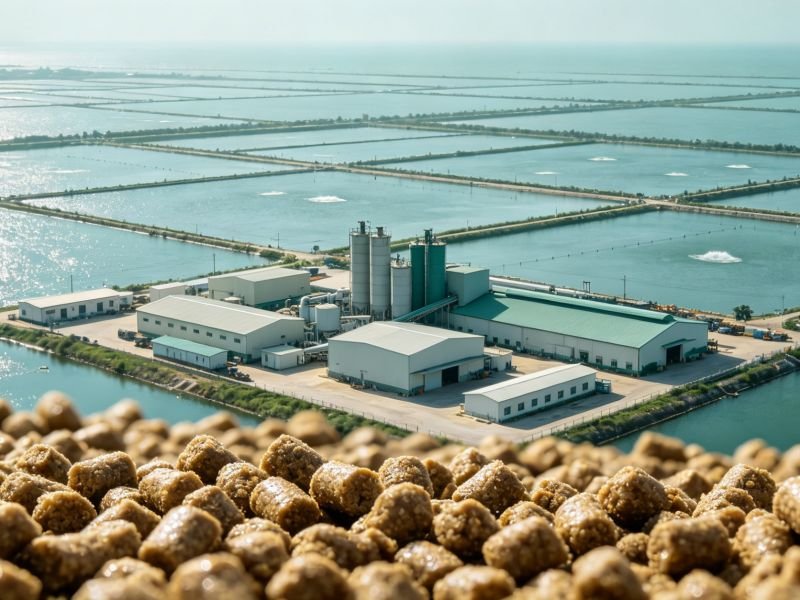
The global aquaculture industry has entered a new stage of development. For decades, producers focused primarily on increasing production volume. Today, however, profitability depends not only on how many fish or shrimp are raised, but also on how efficiently feed is converted into biomass. As feed costs continue to represent the largest operating expense in most aquaculture operations, feed quality has become a decisive factor in determining business success.
Across Asia, South America, Africa, and the Middle East, commercial aquaculture companies are investing heavily in modern feed manufacturing systems. The goal is no longer simply to produce feed pellets. Producers now seek precision nutrition, better pellet stability, optimized digestibility, and lower feed conversion ratios.
This shift is creating strong demand for advanced processing technologies and integrated production systems capable of supporting large-scale aquaculture development.
The Growing Importance of Specialized Feed Production
Aquatic animals have nutritional requirements that differ significantly from those of poultry, cattle, or swine. Fish and shrimp species require carefully balanced protein levels, amino acid profiles, lipids, vitamins, and minerals.
A modern aquafeed plant must therefore be designed to handle a variety of formulations while maintaining strict quality standards throughout production.
Unlike traditional livestock feeds, aquatic feeds must also perform well in water. Poor-quality pellets can disintegrate quickly, causing nutrient loss, water pollution, and reduced animal performance. As environmental regulations become stricter and farmers pursue higher productivity, feed manufacturers are under increasing pressure to deliver consistent products.
This is particularly true in regions where intensive aquaculture operations are expanding rapidly. Producers need feed that remains stable, attractive to aquatic animals, and nutritionally effective throughout the feeding cycle.
Why Shrimp Feed Requires More Advanced Processing
Shrimp farming is among the fastest-growing sectors of global aquaculture. However, shrimp feed manufacturing presents unique technical challenges.
Shrimp feed pellets generally require:
- High water stability
- Precise particle sizes
- Uniform nutritional distribution
- Low dust content
- Strong pellet durability
Because shrimp often feed slowly at the pond bottom, pellets must maintain structural integrity for extended periods. Feed that breaks apart prematurely leads to nutrient waste and deteriorating water quality.
To meet these requirements, many investors are searching for a 2-3 T/H shrimp feed processing plant for sale that can provide reliable production capacity while ensuring product consistency.
A properly designed shrimp feed production system includes raw material handling, grinding, batching, mixing, conditioning, pelleting, cooling, crumbling, screening, and packaging. Each stage contributes to the final pellet quality and directly influences farm performance.
Feed Efficiency: The Hidden Driver of Profit
Many aquaculture businesses focus on feed price when evaluating suppliers. While feed cost is important, feed efficiency often has a far greater impact on profitability.
Consider two feeds:
- Feed A costs slightly less per ton.
- Feed B costs more but achieves a significantly better feed conversion ratio.
Over an entire production cycle, Feed B may generate substantially higher profits because less feed is required to produce the same amount of biomass.
This is why modern feed manufacturers prioritize process control and product consistency. Even small improvements in pellet quality can lead to measurable gains in animal growth performance.
Advanced production systems help manufacturers achieve:
- Better ingredient utilization
- Improved nutrient retention
- Reduced fines generation
- More consistent pellet density
- Enhanced feed conversion performance
The result is a product that creates value throughout the production chain.
Technology Is Transforming Feed Manufacturing
The aquafeed industry has experienced significant technological progress over the last decade.
Modern production facilities increasingly utilize:
Intelligent Batching Systems
Automated batching minimizes formulation errors and improves consistency between production runs. Accurate ingredient dosing is essential for maintaining nutritional specifications.
High-Efficiency Grinding
Particle size distribution directly affects pellet quality and digestibility. Advanced grinding equipment ensures uniform particle preparation before mixing.
Precision Mixing
Uniform ingredient distribution helps guarantee that every pellet delivers the intended nutrient profile.
Advanced Conditioning
Steam conditioning improves starch gelatinization and pellet binding, leading to stronger and more durable products.
Automated Quality Monitoring
Digital control systems enable operators to monitor critical parameters in real time, reducing production variability and improving overall efficiency.
These technologies are helping feed manufacturers meet increasingly demanding customer expectations.
(Related Post: https://www.richipelletmill.com/shrimp-feed-plant/)
Sustainability Is Reshaping Industry Priorities
Sustainability has become a central topic within global aquaculture.
Consumers, retailers, and regulators are demanding more environmentally responsible production practices. Feed manufacturers play a critical role in supporting these objectives.
Modern feed production contributes to sustainability through:
- Improved feed conversion ratios
- Reduced nutrient waste
- Lower emissions per unit of production
- Better raw material utilization
- Reduced environmental impact on aquatic ecosystems
As the industry evolves, feed quality and sustainability are becoming closely linked. Producers who invest in efficient manufacturing systems are often better positioned to meet future market requirements.
Choosing the Right Production Partner
Selecting equipment for a new feed mill is a major investment decision. Beyond machinery specifications, investors should evaluate the overall capabilities of the equipment supplier.
Important considerations include:
Engineering Experience
Suppliers with extensive project experience can provide valuable guidance during planning and implementation.
Customized Solutions
Every project has unique requirements based on species, production goals, raw materials, and market conditions.
Installation Support
Professional installation services help reduce commissioning risks and accelerate production startup.
Technical Training
Operator training ensures that production teams can achieve optimal equipment performance.
Long-Term Service
Reliable technical support and spare parts availability are essential for maintaining operational continuity.
Many investors evaluate suppliers such as Richi Pellet Mill because of their experience in designing customized feed production projects for different aquaculture sectors.
Future Trends in Aquafeed Production
Several trends are expected to shape the next generation of feed manufacturing facilities.
Greater Automation
Automation will continue reducing labor requirements while improving production consistency.
Data-Driven Production
Manufacturers increasingly rely on production analytics to optimize efficiency and identify improvement opportunities.
Alternative Ingredients
The use of novel protein sources, including insect meal and microbial proteins, is expected to expand.
Energy Efficiency
Reducing energy consumption will remain a priority as production costs and environmental concerns increase.
Enhanced Product Customization
Feed producers will develop increasingly specialized products targeting specific species, growth stages, and farming conditions.
Companies that adopt these innovations early may gain significant competitive advantages in emerging aquaculture markets.
Building a Strong Foundation for Long-Term Growth
Successful aquaculture operations depend on many factors, including genetics, water quality, disease management, and farm practices. However, feed remains one of the most influential variables affecting production outcomes.
A well-designed feed manufacturing system provides more than production capacity. It creates the foundation for consistent product quality, improved animal performance, and long-term business growth.
Whether developing a new shrimp feed facility, expanding an existing operation, or entering a new aquaculture market, investing in modern feed production technology can deliver substantial benefits across the entire value chain.
Industry leaders increasingly recognize that competitive advantage comes not only from producing more feed, but from producing better feed. By focusing on efficiency, quality, and innovation, today’s manufacturers are positioning themselves for sustainable success in a rapidly evolving global marketplace.
For investors researching feed production technologies and project solutions, industry resources and technical case studies can provide valuable guidance. If you would like additional information about equipment configurations, operational considerations, and project planning strategies, you can check my source and explore the latest developments shaping the future of aquaculture feed manufacturing.