
From Pellet Formation to Finished Feed
Producing floating fish feed requires more than simply forming pellets that remain on the water surface.
The manufacturer must control particle size, moisture, density, temperature and formulation throughout the process.
Liquid ingredients introduce another important variable.
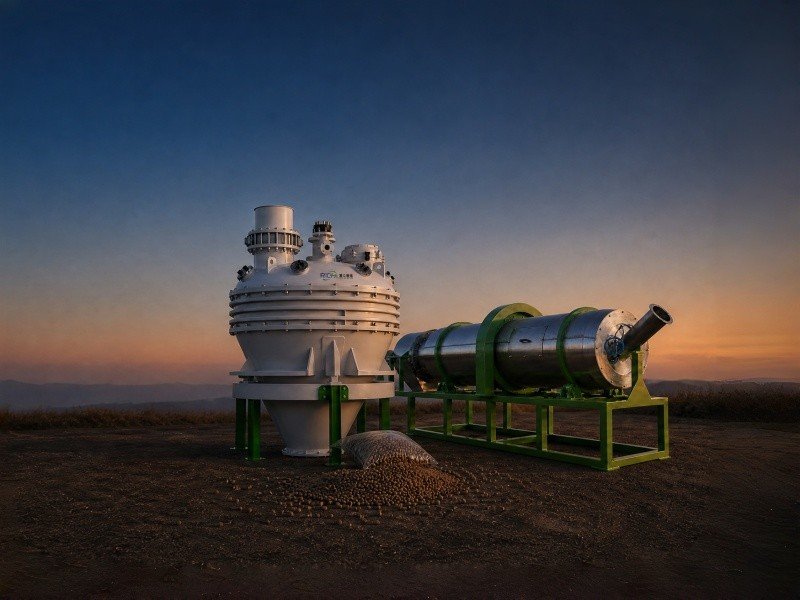
An oil spraying machine can be integrated into the downstream section of a fish feed plant to apply oil or other liquid ingredients in a controlled way.
The technology becomes particularly relevant when the manufacturer wants to adjust the final formulation without placing excessive liquid into the pelletizing or extrusion stage.
What Makes Floating Feed Different?
Floating fish feed is commonly produced through extrusion.
During extrusion, pressure, temperature and moisture interact to create a porous structure that can provide buoyancy.
After extrusion, the pellets normally require drying and cooling before further processing.
If additional oil is needed, the timing of application matters.
Applying too much liquid too early may interfere with the upstream process. Applying a controlled amount after pellet stabilization can provide another way to adjust the final product.
Therefore, liquid application should be planned together with extrusion and drying.
Where Does Spraying Fit?
A simplified floating-feed process may look like this:
Raw material preparation → grinding → batching → mixing → extrusion → drying → cooling → oil application → screening → packaging
The exact process varies by factory.
Some formulations may require liquid ingredients earlier in the process, while others benefit from post-extrusion application.
The important point is that spraying equipment should be positioned according to the product’s actual requirements.
Why Uniform Coverage Matters
Imagine a production stream carrying thousands of pellets every hour.
If liquid is not distributed evenly, some pellets may receive considerably more oil than others.
This can affect surface appearance and formulation consistency.
A controlled spraying system attempts to create a more uniform distribution.
The result depends on many factors, including pellet flow, nozzle design, liquid properties and mixing movement.
For this reason, equipment configuration should be tested against actual production conditions.
What Capacity Is Suitable for a Small Floating Feed Factory?
A smaller factory may only need 0.5–1.0 T/H of production.
In this case, a 0.5–1.0 T/H floating fish feed production line for sale may be designed around a compact process with appropriate grinding, mixing, extrusion, drying, cooling and liquid application equipment.
The spraying system should match the actual throughput.
An oversized liquid system may provide little practical advantage if the factory operates at a low and relatively stable production rate.
At the same time, the design should leave reasonable room for future changes in production.
How Does Oil Affect Pellet Processing?
Oil can influence the physical properties of feed.
Depending on the formula and application point, it may affect lubrication, surface characteristics, palatability and energy density.
However, excessive oil can also influence pellet formation and downstream handling.
This is why oil addition should be controlled rather than maximized.
The correct dosage comes from the feed formulation, not from the maximum capability of the spraying equipment.
Why Is a Cooling Stage Important?
Extruded floating feed can leave the dryer or extruder at elevated temperatures.
Before further handling, the pellets normally need to be cooled and stabilized.
A controlled temperature helps make downstream oil application more predictable.
If the pellets are too hot, liquid viscosity and surface interaction may change.
A properly designed cooling stage can therefore contribute indirectly to the stability of the spraying process.
Choosing a Spray System for Different Oils
Not every oil behaves in the same way.
Vegetable oils may have different viscosity characteristics from fish oil or other liquid fats.
Some materials may require heating to maintain stable flow.
For this reason, the liquid tank and pipeline system should be considered alongside the spray chamber.
A complete installation can include heating, insulation, filtration and controlled pumping where necessary.
Can the Same System Handle Several Products?
Potentially, but product changeover must be considered.
A factory producing several species-specific fish feeds may have different oil requirements for different formulations.
The control system should allow operators to adjust liquid dosage accurately.
Cleaning procedures should also be practical.
The goal is not simply to make the system flexible on paper, but to make real production changeovers manageable.
What Should Be Automated?
At minimum, the liquid flow should be controllable.
For a more advanced production line, the spraying system can be integrated with the main control system.
The production rate, pump speed and liquid dosage can then be coordinated.
This reduces the need for constant manual adjustment.
Automation can also help production staff reproduce established processing parameters when switching between product formulas.
How Does Spraying Affect the Overall Feed Plant?
A spraying system may be physically smaller than the extrusion or drying section, but its position in the process can still be significant.
If the liquid application is unstable, the final product can vary even when upstream equipment operates normally.
Therefore, a feed plant should be considered as a chain.
Grinding influences mixing.
Mixing influences extrusion.
Extrusion influences drying.
Drying influences cooling.
Cooling influences liquid application.
Liquid application influences the final product.
Each stage needs to work within the appropriate operating range.
(Related Post: https://www.richipelletmill.com/fish-feed-processing-line/)
What About Equipment Investment?
Buyers often focus on the purchase price of the spraying machine.
However, the total project cost may also include the liquid tank, pump, heating system, pipelines, electrical controls, conveyors and installation.
For a complete fish feed pellet line, these components should be evaluated as part of the overall investment.
A lower-cost standalone machine may not necessarily be the most practical choice if substantial modifications are required later.
Questions to Ask Before Purchasing
A buyer can prepare several key technical questions:
- What is the actual operating capacity?
- What liquids can the system handle?
- Is heating required?
- What oil dosage range is possible?
- How is liquid flow controlled?
- What pellet temperature is recommended?
- How easy is nozzle cleaning?
- Can the system be integrated with existing conveyors?
- Can the control system store different formulas?
- What maintenance parts are required?
These questions are more useful than comparing equipment only by model name.
Designing for Future Production
A startup plant may begin with one floating feed product.
After entering the market, it may add shrimp feed, sinking feed or feeds for different fish species.
Equipment designed only for the initial product may become restrictive.
A flexible liquid application system can therefore be useful for future product expansion.
However, flexibility should be based on realistic plans rather than unnecessary complexity.
What Makes a Practical Solution?
A practical system is one that matches:
Product + formulation + capacity + liquid characteristics + process sequence
There is no universal spraying configuration.
The same principle applies to the wider production line.
A small factory may prioritize simplicity.
A medium-sized factory may prioritize flexibility.
A large industrial plant may place greater emphasis on automation and continuous operation.
Understanding this difference makes equipment selection more rational.
Final Considerations
Oil application is only one part of floating fish feed production, but it can become an important process when liquid ingredients are required after pellet formation.
The best results come from treating the spraying system as part of the complete production process.
The manufacturer should evaluate extrusion, drying, cooling, liquid handling and packaging together.
For companies researching equipment configurations and feed-processing technology, about this can be used as an additional reference when comparing related solutions.
The goal is ultimately straightforward: create a controlled process that produces consistent feed while allowing the factory to operate efficiently and adapt to changing product requirements.