
Every morning, poultry farmers face the same reality. The birds have been eating, and what goes in must come out. By the end of the week, there’s a pile. By the end of the month, it’s a mountain. The manure accumulates faster than most farmers can manage it, and the options for disposal are never ideal. Spread it on fields, and you risk nutrient runoff. Pay someone to haul it away, and you’re adding to your operating costs. Leave it piled up, and you’re inviting complaints from neighbors and regulators.
It’s a problem that has plagued poultry farming for as long as birds have been raised in confinement. But a growing number of farmers are looking at that pile differently. Instead of seeing a disposal problem, they’re seeing a resource. The same manure that costs them money to manage can, with the right processing, become a product that generates revenue.
The True Cost of Manure
Most farmers don’t calculate the full cost of manure management. The obvious costs are the labor and equipment needed to move the material. There’s the fuel for the tractors and trucks. There may be fees for hauling or land application. But there are also less visible costs. Storage facilities require space and maintenance. Odor complaints can strain relationships with neighbors. And environmental regulations carry the risk of fines for non-compliance.
For a typical poultry operation, these costs add up. The USDA has estimated that manure management can represent 5% to 15% of total production costs for some operations. That’s a significant portion of the budget—and it’s money that provides no return to the farm.
The irony is that the manure itself contains value. It’s rich in nitrogen, phosphorus, and potassium—the same nutrients that farmers pay good money for in synthetic fertilizers. The challenge has always been capturing that value in a form that’s practical to handle and apply.
What Makes Poultry Manure Different?
Poultry manure is not like other livestock waste. It’s more concentrated in nutrients, with higher nitrogen and phosphorus levels than cattle or pig manure. This concentration makes it more valuable as a fertilizer—but it also makes it more challenging to manage.
The high nitrogen content means that raw poultry manure can burn crops if applied fresh. The phosphorus content means that over-application can lead to water quality problems. And the ammonia emissions from stored manure can create odor issues.
Poultry manure also has a different physical character. It tends to be drier than cattle manure, with a lower moisture content that makes it easier to handle. But it’s also more variable. The bedding material—wood shavings, rice hulls, or straw—adds its own characteristics. The feed formulation affects the nutrient profile. The age of the manure affects its properties.
This variability is one of the reasons that poultry manure can be difficult to market. Buyers want consistency, and raw manure doesn’t deliver it. Processing the manure into a uniform, stabilized product is the key to creating a marketable item.
The Processing Solution
Manure processing addresses the variability issue by creating a consistent product. The material is dried, ground, and pelletized. The result is a uniform pellet that can be sold as organic fertilizer or used as a biomass fuel.
The processing steps are straightforward. Drying removes the bulk of the moisture, concentrating the nutrients and creating a stable material. Grinding homogenizes the material, reducing the variability. And pelletizing creates a dense, uniform product that’s easy to handle and apply.
Drying is the most energy-intensive step. The moisture content of fresh poultry manure typically ranges from 25% to 35%. For effective pelletizing, this needs to be reduced to 12% to 15%. This can be done through mechanical drying or through natural drying in a covered area.
Grinding follows drying. The material is reduced to a consistent particle size. This step is important because it ensures that the material feeds smoothly through the pelletizing machine and produces uniform pellets.
Pelletizing is the final step. The ground material is conditioned with steam and then forced through a die. The heat and pressure create dense, durable pellets that can be stored for extended periods.
Small-Scale Processing Options
Not every poultry operation produces enough manure to justify a large-scale processing facility. For smaller farms—those with a few thousand birds or less—the economics of large-scale equipment may not work. This is where smaller processing options come into play.
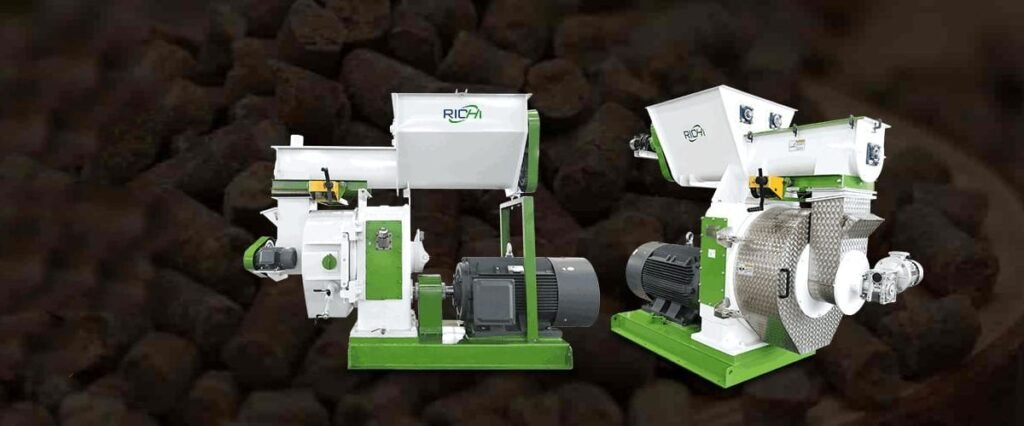
A household poultry manure pellet machine is designed for exactly this market. These machines are compact, affordable, and designed for intermittent operation. They can process 50 to 200 kilograms of manure per hour, which is sufficient for smaller flocks.
The household poultry manure pellet machine is typically simpler in design than its industrial counterparts. The capacity is lower, the power requirements are less, and the initial investment is more accessible. For a small farm, this machine can be the difference between paying for manure disposal and generating a saleable product.
The operation of a household poultry manure pellet machine is straightforward. The dried and ground manure is fed into the machine, where it’s compressed into pellets. The machine requires minimal operator attention and can be run by a single person.
Making the Decision
For many farmers, the key question is whether the investment in a poultry manure processing machine makes economic sense. The answer depends on several factors.
First, consider the current cost of manure management. If you’re paying for hauling, or if you’re spending significant labor on manure handling, then processing may offer savings. The avoided cost of disposal is a real benefit that should be included in the calculation.
Second, consider the potential revenue from the processed product. Organic fertilizer prices vary by region and by quality. In many areas, poultry manure pellets command premium prices from organic growers and vegetable producers. The revenue from pellet sales can offset the operating costs of the processing line.
Third, consider the scale. The economics improve with volume. A farm that produces a significant amount of manure can justify a larger investment in processing equipment. The per-unit cost of processing decreases as the volume increases.
Fourth, consider the markets. Who in your region would buy manure pellets? Organic farmers, landscapers, and even residential gardeners may be potential customers. The market conditions in your area will affect the revenue potential.
The Equipment Landscape
The pellet machine for sale market includes a wide range of options. For poultry manure, the equipment must be matched to the specific characteristics of the material.
The die is the most important component for poultry manure processing. The die holes must be sized correctly for the intended product, and the die must be made from wear-resistant material. Poultry manure can be abrasive, and a die that’s not designed for this application will wear quickly.
The feeding mechanism is also important. Poultry manure can be variable in consistency, and the feeding system must handle the material without clogging. A positive-feed system that forces the material into the die chamber is more reliable than a gravity-feed system for this application.
The power requirements depend on the capacity of the machine. A larger machine will require more power, but will also produce more product per hour. The power source—whether electric motor or diesel engine—affects the operating costs.
The control system determines how easy the machine is to operate. A basic machine may have simple controls that require operator adjustment. A more advanced machine may have automated controls that monitor and adjust parameters automatically.
A Farm’s Experience
Consider a poultry farm that installed a small processing line. The farm had 5,000 birds in production, generating about 100 tons of manure annually. The manure was spread on the farm’s own fields, but the farm had more manure than it could use. The excess was piled up and eventually hauled away.
The farm owner calculated that the hauling cost was about $50 per ton, totaling $5,000 annually. The investment in a small pelletizing line was about $20,000. The operating costs, including electricity and labor, were about $30 per ton.
After installing the processing line, the farm produced about 30 tons of pellets annually. The pellets were sold to organic vegetable growers at $250 per ton. The revenue from pellet sales was $7,500. The avoided hauling cost was $5,000. The total benefit was $12,500 per year. The payback period for the equipment was about 18 months.
The Technology and Its Evolution
The technology for processing poultry manure has evolved significantly. Early machines were often adapted from other applications and didn’t handle poultry manure well. The abrasive nature of the material caused premature wear, and the variable moisture content caused operational problems.
Modern machines are designed specifically for poultry manure. The components are chosen for their resistance to abrasion. The feeding mechanisms are designed to handle variable material. The control systems manage the process to maintain consistency.
The evolution continues. New materials and new designs are extending the life of components. Improved control systems are making operation easier and more consistent. And the growing market for organic fertilizer is driving continued innovation.
The Bottom Line
Poultry manure doesn’t have to be a problem. With the right equipment and the right approach, it can be a valuable resource. The technology is accessible, and the markets are growing. For poultry farmers willing to make the investment, manure processing can turn a liability into an asset.
The decision is not just about economics. It’s also about control. Processing on the farm gives the farmer control over the product quality and the timing of sales. It reduces dependence on external haulers and processors. And it provides a tangible way to improve the farm’s environmental performance.
View more:https://pelletizerextruder.com/chicken-manure-pellet-machine/