
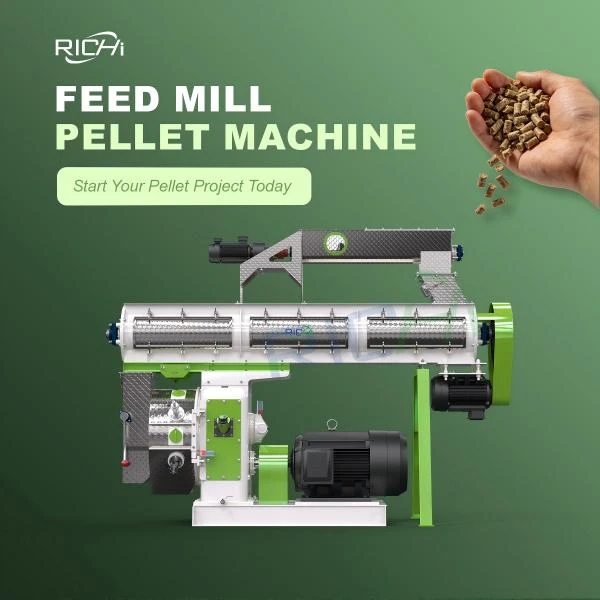
Poultry feed pellets are widely used in modern poultry farming because they are easy to handle, transport, store, and distribute. Compared with mash feed, properly produced pellets can help reduce feed waste, minimize ingredient separation, and provide poultry with a more uniform nutrient intake.
However, making high-quality poultry feed pellets requires more than a single pellet machine. Depending on the production capacity, raw materials, feed formula, pellet specifications, and degree of automation, a poultry feed production system may include raw material cleaning equipment, crushing machines, batching systems, mixers, conditioners, pellet mills, coolers, screening machines, crumbler systems, coating equipment, conveyors, and packaging machines.
So, what equipment is needed to make poultry feed pellets?
The answer depends largely on the scale of production. A small farm may only need a small chicken feed pellet machine and several auxiliary machines, while a commercial feed factory may require a complete automated poultry feed pellet production line.
This article explains the main equipment used in poultry feed pellet production, the function of each machine, and how these machines work together to produce consistent and high-quality poultry feed pellets.
1. Raw Material Receiving Equipment
The first equipment section in a poultry feed plant is the raw material receiving system.
Poultry feed ingredients may include corn, wheat, soybean meal, rice bran, wheat bran, rapeseed meal, fish meal, minerals, vitamins, and various feed additives.
These materials may arrive in bags or in bulk. The receiving system transfers the materials into storage bins, silos, or warehouses.
Typical equipment includes:
- Receiving hoppers
- Feed conveyors
- Bucket elevators
- Screw conveyors
- Dust collection systems
- Storage bins
- Grain silos
A well-designed receiving system makes it easier to unload raw materials quickly and transfer them to the appropriate storage locations.
For large poultry feed factories, efficient raw material handling can significantly reduce labor requirements and improve the continuity of production.
2. Raw Material Cleaning Equipment
Raw materials may contain stones, metal fragments, dust, soil, strings, husks, and other foreign materials.
These contaminants should be removed before the ingredients enter the crushing and pelleting equipment.
Common cleaning machines include:
Vibrating Screen
A vibrating screen separates materials according to particle size and removes larger unwanted particles.
Rotary Screen
A rotary screener can continuously remove impurities from grain and other bulk materials.
Magnetic Separator
A magnetic separator removes ferrous metal particles from the feed stream.
Pre-Cleaner
A pre-cleaning system can remove dust and larger foreign materials before further processing.
Cleaning equipment protects the hammer mill, mixer, pellet mill, conveyors, and other machinery from unnecessary wear and damage.
It also contributes to feed hygiene and finished product quality.
3. Hammer Mill for Feed Crushing
A hammer mill is one of the most important machines in a poultry feed production line.
Many raw materials, particularly corn, wheat, and other grains, need to be reduced to a suitable particle size before mixing and pelleting.
The hammer mill uses high-speed rotating hammers to break the material into smaller particles.
Appropriate grinding can improve:
- Mixing uniformity
- Pellet formation
- Pellet durability
- Feed consistency
- Digestibility
- Production stability
The required particle size depends on the poultry type, feed formula, and pellet diameter.
For example, feed intended for young chicks may require a different particle size from feed intended for mature layers.
Grinding should not simply aim for the finest possible particles. Excessive grinding increases energy consumption and can create unnecessary dust.
Therefore, the hammer mill should be configured according to the actual feed production requirements.
4. Feed Storage Bins
After crushing, ingredients need to be stored temporarily before batching.
Storage bins allow different ingredients to be separated and supplied to the batching system according to the feed formula.
A commercial poultry feed plant may have multiple bins for:
- Corn
- Wheat
- Soybean meal
- Bran
- Protein meals
- Minerals
- Other ingredients
The number and size of bins depend on the number of raw materials and the production capacity.
Proper storage bin design helps maintain a stable material flow and simplifies automated batching.
5. Automatic Batching System
Accurate batching is essential for producing nutritionally consistent poultry feed.
An automatic batching system weighs each ingredient according to the preset feed formula.
Major ingredients may be weighed using larger scales, while vitamins, minerals, amino acids, and other micro-ingredients can be handled by precision dosing systems.
The batching system generally consists of:
- Ingredient bins
- Weighing hoppers
- Load cells
- Screw feeders
- Gates
- Control system
Automatic batching offers several advantages:
- High weighing accuracy
- Consistent formulas
- Reduced labor
- Faster production
- Easier formula changes
- Reduced human error
For commercial feed mills, automatic batching is an important part of the overall automation system.
6. Poultry Feed Mixer
After batching, all ingredients must be thoroughly mixed.
A feed mixer creates a uniform mixture by distributing different ingredients throughout the batch.
Common mixers include:
- Horizontal paddle mixers
- Ribbon mixers
- Double-shaft mixers
- Vertical mixers
Horizontal mixers are widely used in commercial poultry feed production because they can provide efficient mixing and can be integrated easily into automated production lines.
Mixing is particularly important for micro-ingredients such as vitamins, minerals, amino acids, and additives.
If the feed is not mixed sufficiently, different pellets may contain different nutrient concentrations.
A good mixer therefore improves both feed quality and pellet consistency.
7. Steam Conditioner
A conditioner is commonly installed before the pellet mill.
The purpose of conditioning is to add heat and moisture to the feed mixture, usually through steam.
During conditioning, the feed becomes softer and more suitable for compression.
Proper conditioning can:
- Improve pellet durability
- Reduce fines
- Improve starch gelatinization
- Increase pellet mill capacity
- Reduce energy consumption
- Improve pellet appearance
Conditioning parameters should be adjusted according to the specific feed formula.
Different formulas have different requirements for temperature, moisture, steam addition, and retention time.
For high-capacity poultry feed plants, multiple conditioning stages may be considered when more intensive conditioning is required.
8. Small Chicken Feed Pellet Machine
For small farms, household poultry operations, and small feed businesses, a small chicken feed pellet machine can be a practical solution.
This type of machine is designed for relatively small-scale poultry feed production and is generally more compact than industrial pellet mills.
https://pelletisingmachine.com/chicken-feed-pellet-making-machine
A small chicken feed pellet machine can be used to process mixtures containing ingredients such as:
- Corn
- Wheat
- Soybean meal
- Bran
- Rice
- Grain by-products
- Other suitable feed ingredients
Its main function is to compress the prepared feed mixture through a die and form cylindrical pellets.
Small-scale users may choose this type of equipment when they want to produce feed on their own farm rather than purchasing finished commercial feed.
The advantages of a small pellet machine can include:
- Compact structure
- Lower initial investment
- Simple operation
- Convenient installation
- Relatively low space requirements
- Suitable for small production volumes
However, a small pellet machine should not be selected solely based on its physical size. Buyers should also consider the feed formula, pellet diameter, expected production capacity, motor power, and operating hours.
For farms with rapidly increasing feed requirements, a larger pellet mill may be more appropriate.
9. Commercial Chicken Feed Pellet Mill
Large poultry feed factories generally require industrial pellet mills rather than small-scale equipment.
A commercial pellet mill can process larger quantities of feed continuously.
The machine normally consists of:
- Feeding system
- Conditioner
- Pelletizing chamber
- Ring die
- Pressure rollers
- Main drive system
- Motor
- Lubrication system
- Discharge system
- Safety protection system
Inside the pellet mill, rollers compress the conditioned feed against the ring die. The feed is forced through die holes and cut into pellets.
The die hole diameter determines pellet diameter, while the cutter controls pellet length.
Commercial pellet mills are available in different capacities and configurations to meet different poultry feed production requirements.
10. Ring Die
The ring die is one of the key components of a commercial poultry feed pellet mill.
It determines the diameter of the finished pellets and strongly influences compression conditions.
Different feed products may require different die specifications.
The appropriate die should be selected according to:
- Feed formula
- Raw material characteristics
- Pellet diameter
- Production capacity
- Required pellet durability
A worn die can reduce production efficiency and increase the percentage of fines.
Therefore, regular inspection and timely replacement of worn dies are important for maintaining stable production.
11. Pressure Rollers
Pressure rollers work together with the ring die to compress the feed material.
The rollers apply pressure to the feed and force it through the die holes.
Roller condition and adjustment can affect:
- Pellet quality
- Production capacity
- Energy consumption
- Machine load
- Die wear
The roller gap should be properly adjusted to maintain stable compression.
Wear-resistant roller shells can help extend service life in continuous commercial operations.
12. Pellet Cooler
Fresh poultry feed pellets leaving the pellet mill are hot and contain relatively high moisture.
A pellet cooler is therefore required before the product can be safely stored and packaged.
A counterflow cooler is widely used in commercial feed production.
The cooler removes heat and excess moisture from the pellets by passing air through the pellet bed.
Efficient cooling helps:
- Improve pellet stability
- Reduce condensation
- Reduce mold risk
- Improve storage performance
- Prepare pellets for screening
The cooling capacity should be matched to the output of the pellet mill.
If the cooler is too small, it can become a bottleneck and reduce overall production efficiency.
13. Pellet Screening Machine
After cooling, pellets are screened.
The screening machine separates qualified pellets from:
- Fines
- Broken pellets
- Oversized particles
- Other irregular material
The qualified pellets continue to packaging, while fines can often be recycled into the pelleting process.
Screening improves the appearance and consistency of the finished product.
It also reduces the amount of powder delivered to poultry farms.
14. Feed Crumbler
Young chicks often require smaller particles than mature poultry.
A feed crumbler can therefore be installed after the cooling stage.
The crumbler breaks larger pellets into smaller particles.
The process is generally:
Pelleting → Cooling → Crumbling → Screening
This allows a feed mill to produce starter crumbles for chicks while still using the same basic pelleting system to produce standard pellets for older poultry.
A crumbler also provides greater flexibility for feed manufacturers producing multiple product sizes.
15. Pellet Coating Machine
Some poultry feed formulas require additional liquid ingredients after pelleting.
A coating machine can apply oil or other suitable liquid ingredients to the pellet surface.
Post-pellet coating can be useful when certain ingredients need to be added after high-temperature processing.
A good coating system should provide uniform spraying and accurate dosing.
Excessive liquid application should be avoided because it can negatively affect pellet stability and storage.
16. Automatic Packaging Machine
The final equipment section is packaging.
After cooling, screening, and optional coating or crumbling, the finished feed is weighed and packed into bags.
An automatic packaging machine can perform several functions:
- Weighing
- Bag filling
- Bag clamping
- Sealing
- Counting
- Conveying
Automatic packaging improves packing accuracy and reduces manual labor.
For large poultry feed factories, automated bagging can be integrated with palletizing and warehouse systems.
17. Conveying Equipment
Conveyors are essential for connecting different machines.
Common conveying equipment includes:
- Screw conveyors
- Belt conveyors
- Bucket elevators
- Chain conveyors
- Pneumatic conveying systems
The selection depends on material characteristics, transportation distance, equipment layout, and production capacity.
Efficient conveying reduces material handling time and helps maintain continuous production.
The conveying system should be designed to minimize material accumulation and unnecessary transportation distances.
18. Dust Collection System
Dust is generated during raw material receiving, cleaning, crushing, mixing, and other processing stages.
A dust collection system helps capture airborne particles and improve the working environment.
It can include:
- Cyclones
- Bag filters
- Dust collectors
- Air ducts
- Fans
A properly designed dust collection system also helps reduce material loss and protect equipment from dust accumulation.
For commercial poultry feed plants, dust control should be considered during the overall factory design process.
19. Electrical Control System
Modern poultry feed plants often use a centralized electrical control system.
A PLC-based system can coordinate different equipment and monitor production conditions.
Operators can monitor:
- Motor status
- Feed flow
- Temperature
- Production rate
- Equipment alarms
- Batching information
- Pellet mill load
Automation can reduce manual intervention and improve production consistency.
For large production lines, the control system can also store multiple feed formulas and automatically switch between products.
Equipment Needed for Different Poultry Feed Production Scales
The equipment configuration should match the scale of the project.
Small-Scale Poultry Feed Production
A small farm may use:
Raw Material Crusher → Mixer → Small Chicken Feed Pellet Machine → Cooler/Manual Cooling → Screening → Packaging
This configuration is suitable for relatively low production volumes and on-farm feed production.
The main advantages are simple operation, lower investment, and compact layout.
Medium-Scale Production
A medium-sized poultry feed plant may require:
Cleaning → Crushing → Batching → Mixing → Conditioning → Pelletizing → Cooling → Screening → Packaging
Automatic batching and conveying systems can be introduced to improve production efficiency.
Large Commercial Feed Factory
A large commercial poultry feed production line may include:
Raw Material Receiving → Cleaning → Storage → Crushing → Automatic Batching → Mixing → Steam Conditioning → Multiple Pellet Mills → Cooling → Screening → Crumbling → Coating → Packaging → Finished Product Storage
Additional equipment can include centralized PLC control, dust collection systems, silos, automatic warehouse systems, and quality control laboratories.
How to Choose the Right Poultry Feed Pellet Equipment
Several factors should be considered before purchasing equipment.
1. Production Capacity
Determine the target output in tons per hour.
A small farm may require a compact machine, while a commercial feed factory may need several high-capacity pellet mills.
2. Feed Formula
Different formulas have different grinding, mixing, conditioning, and pelleting requirements.
Equipment should be selected according to the actual ingredients.
3. Pellet Diameter
Confirm the required pellet size before selecting the die.
Chick feed usually requires smaller particles than feed for mature poultry.
4. Automation Requirements
Decide whether the plant will use manual, semi-automatic, or fully automatic operation.
5. Factory Space
The equipment layout should fit the available building while maintaining efficient material flow.
6. Maintenance and Spare Parts
The availability of wear parts and technical support is important for long-term operation.
7. Future Expansion
If production is expected to increase, the factory layout should leave sufficient space for additional equipment.
Why a Complete Poultry Feed Production Line Is Better Than a Single Machine
A pellet machine alone cannot efficiently complete the entire feed production process.
For example, if raw materials are not properly crushed, the pellet mill may consume more energy or produce weak pellets. If mixing is poor, the nutritional composition may vary. If conditioning is insufficient, pellet durability may decrease. If cooling capacity is inadequate, finished pellets may not be suitable for storage.
A complete production line coordinates all these processes.
The main benefits include:
- Stable material flow
- Better pellet quality
- Higher production efficiency
- Lower manual labor
- Improved automation
- Easier quality control
- Better scalability
Therefore, commercial customers should evaluate the entire production system rather than selecting equipment based only on the pellet mill.
RICHI Poultry Feed Pellet Production Equipment
RICHI Pellet Machine provides customized poultry feed pellet equipment and turnkey production line solutions for customers with different production requirements.
For small farms and small feed businesses, a small chicken feed pellet machine can be configured as part of a compact production system.
For larger projects, RICHI can provide complete production lines integrating:
Cleaning → Crushing → Batching → Mixing → Conditioning → Pelletizing → Cooling → Screening → Crumbling/Coating → Packaging
The equipment configuration can be customized according to the customer’s raw materials, feed formula, target capacity, pellet diameter, factory layout, automation requirements, and investment budget.
A turnkey project can include production process design, equipment manufacturing, transportation, installation, commissioning, operator training, and after-sales technical support.
This approach allows the entire production line to be designed as one coordinated system instead of purchasing unrelated machines separately.
Conclusion
So, what equipment is needed to make poultry feed pellets?
The answer depends on production scale and product requirements.
A small farm may only need a crusher, mixer, small chicken feed pellet machine, cooling system, screening equipment, and packaging equipment. A medium-sized plant may require automatic batching and steam conditioning, while a large commercial feed factory may need a complete automated system covering raw material receiving, cleaning, grinding, batching, mixing, conditioning, pelletizing, cooling, screening, crumbling, coating, and packaging.
The pellet machine is the core of the production process, but high-quality poultry feed pellets depend on the entire equipment system. Proper raw material preparation, accurate batching, uniform mixing, effective conditioning, stable pelleting, efficient cooling, and reliable screening all contribute to final product quality.
When selecting poultry feed production equipment, manufacturers should consider production capacity, feed formulas, pellet specifications, automation, factory space, maintenance requirements, and future expansion.
With a properly designed production line and suitable equipment, poultry feed producers can manufacture uniform, durable, and nutritionally consistent pellets while improving production efficiency and reducing operating costs.