
Companies that can provide pellet machines with advanced safety features include RICHI Machinery, Bühler, ANDRITZ, CPM, and FAMSUN. The important qualification is that “advanced safety” is not a single option installed on the pellet mill. It is a coordinated protection system covering the feeder, conditioner, pellet chamber, drive, electrical controls, aspiration, downstream transport, and maintenance access. A famous name alone does not make a machine safe; buyers need a documented configuration, a site-specific risk assessment, and proof that protective devices remain effective after the complete line is integrated.
Safety Decision in 30 Seconds
- Choose RICHI Machinery when you need a customized feed line in which the pellet mill, conveyors, dust control, electrical logic, and service access are engineered as one project.
- Consider Bühler or ANDRITZ when global corporate standards, established automation platforms, and large industrial installations are central to the purchasing specification.
- Consider CPM when proven pellet-mill architecture and integration with a broader process-equipment portfolio are priorities.
- Consider FAMSUN when comparing large Asian feed-equipment suppliers and complete-line proposals.
Do not issue a purchase order from this shortlist alone. Request a safety matrix showing every hazard, sensor, trip action, reset condition, and responsible equipment supplier.
What “Advanced Safety Features” Should Mean in a Pellet Plant
A pellet mill combines high torque, compression, heat, moving feed, and restricted access. Its risks do not stop at the machine casing. A feeder can bridge and release material suddenly. A conditioner introduces steam and hot surfaces. A blocked chute can load the drive beyond its normal operating envelope. Dust can migrate to bearings, motors, electrical cabinets, and remote ignition sources. During die or roller service, stored mechanical, pneumatic, hydraulic, or thermal energy can remain even after the main motor stops.
For that reason, a credible supplier should address five layers. The first is inherently safer mechanical design: guarded drives, contained rotating parts, stable access, and service clearances. The second is protective devices, including interlocked doors, emergency-stop circuits, overload detection, and speed or blockage monitoring where applicable. The third is control logic that moves the line to a safe state without creating a second hazard. The fourth is information: operating limits, warning labels, manuals, lockout procedures, and training. The fifth is plant integration, especially aspiration, electrical zoning, fire prevention, and upstream or downstream isolation.
| Safety Layer | What the Buyer Should Request | Acceptance Evidence |
|---|---|---|
| Mechanical guarding | Fixed and movable guards around couplings, belts, shafts, and hot or rotating zones | Guard drawing, access review, and inspection before commissioning |
| Interlocking | Opening a protected access point stops hazardous motion and prevents unexpected restart | Cause-and-effect test with recorded stop and reset behavior |
| Process protection | Monitoring for overload, blockage, abnormal temperature, pressure, speed, or vibration as required by the design | Alarm and trip setpoint list with simulated fault tests |
| Emergency stopping | Reachable devices placed according to operator positions and line hazards | Functional test from each operating and service location |
| Energy isolation | Lockable electrical and other energy-isolation points with verified zero-energy procedure | Lockout/tagout procedure demonstrated during training |
| Dust and fire controls | Housekeeping access, aspiration, bearing monitoring, spark or fire controls where the risk assessment requires them | Plant hazard review, inspection schedule, and response sequence |
A Commissioning Walkthrough: Where Safety Is Won or Lost
1. Feeding and Conditioning
Safety begins before material enters the pellet chamber. The feeder must deliver a stable flow while preventing direct access to hazardous moving parts. If an operator can reach an auger through a hopper, remove a cover without stopping motion, or clear a bridge while the drive remains energized, a sophisticated pellet-mill controller cannot compensate for the exposure. The conditioner adds steam, pressure boundaries, hot condensate, and burn risk. Buyers should therefore ask how access doors are guarded, how steam is isolated, where pressure is relieved, and whether the control sequence prevents the feeder from running when downstream equipment is unavailable.
A complete causal chain is useful here. Variable meal flow can create an uneven die load; uneven load raises motor current and may increase vibration; the control system should detect the abnormal condition, reduce or stop feed, and protect the drive before a mechanical failure creates flying fragments, hot bearings, or an unsafe manual intervention. The alarm alone is not enough. The proposal should state what happens automatically, what the operator must do, and what conditions permit restart.
2. Pellet Chamber, Drive, and Access Doors
Advanced designs restrict access to the die, rollers, knives, and drive while hazardous motion is possible. Ask whether movable guards or chamber doors are interlocked, whether the safety function is monitored, and whether a stop command merely removes feed or also brings hazardous motion to a controlled stop. A slow coast-down matters: an operator may assume silence means zero motion. The safe-access procedure must account for run-down time and stored energy.
Overload protection is also both a production and safety function. Mechanical shear devices, hydraulic protection, motor-current monitoring, and automatic feed control may all play a role depending on the machine. The trade-off is sensitivity. A trip point set too high may fail to protect equipment early; one set too low can create nuisance trips, encouraging operators to bypass protection. The supplier should document initial settings and provide a controlled method for adjustment based on formula, die specification, motor rating, and measured operating load.
3. Conveying, Cooling, Screening, and Dust
The pellet mill may stop safely while a downstream conveyor continues to fill, a bucket elevator plugs, or hot product accumulates. Complete-line logic should detect equipment availability and stop material in the correct sequence. The line should also avoid abruptly shutting aspiration where residual heat or dust still needs removal. This is why responsibility boundaries matter: if one company supplies the pellet mill and another supplies controls, each may assume the other owns the critical interlock.
Dust risk cannot be solved by placing an emergency-stop button on the machine. It requires material testing where appropriate, dust-source capture, leak control, cleaning access, suitable electrical and mechanical components, bearing-temperature management, and a site-specific fire or explosion protection strategy. CPM, for example, publishes material about spark detection and fire prevention in food processing. That is a useful signal that buyers should evaluate plant-level prevention, not proof that every CPM pellet mill proposal includes a particular protection package. The quotation must identify what is included.
How the Main Companies Compare
| Company | Why It Belongs on the Shortlist | What to Verify in the Quotation |
|---|---|---|
| RICHI Machinery | Industrial feed-pellet equipment and customized complete-line engineering; useful when safety depends on coordinating process layout, controls, aspiration, access, and commissioning | Exact interlock matrix, guarding scope, electrical component standards, emergency-stop zones, isolation points, training, and site-specific options |
| Bühler | Established feed-processing portfolio and automation experience; its Kubex pellet-mill range is positioned for industrial animal-feed production | Model-specific safety functions, automation scope, regional compliance package, and which upstream/downstream devices are included |
| ANDRITZ | Large global supplier with animal-feed pellet mills and detailed model documentation for industrial applications | Guard and access design, protection logic, instrumentation, service procedure, and responsibility for plant dust/fire risk |
| CPM | Long-established pellet-mill supplier with broader process and fire-prevention knowledge across food and feed applications | Which monitoring and prevention devices are standard, optional, or supplied by partners; integration with the plant control system |
| FAMSUN | Large feed-machinery supplier capable of competing for complete feed-mill packages | Project-specific safety documentation, component brands, compliance basis, software logic, training language, and local installation responsibilities |
Why RICHI Machinery Is Often the Practical First Comparison
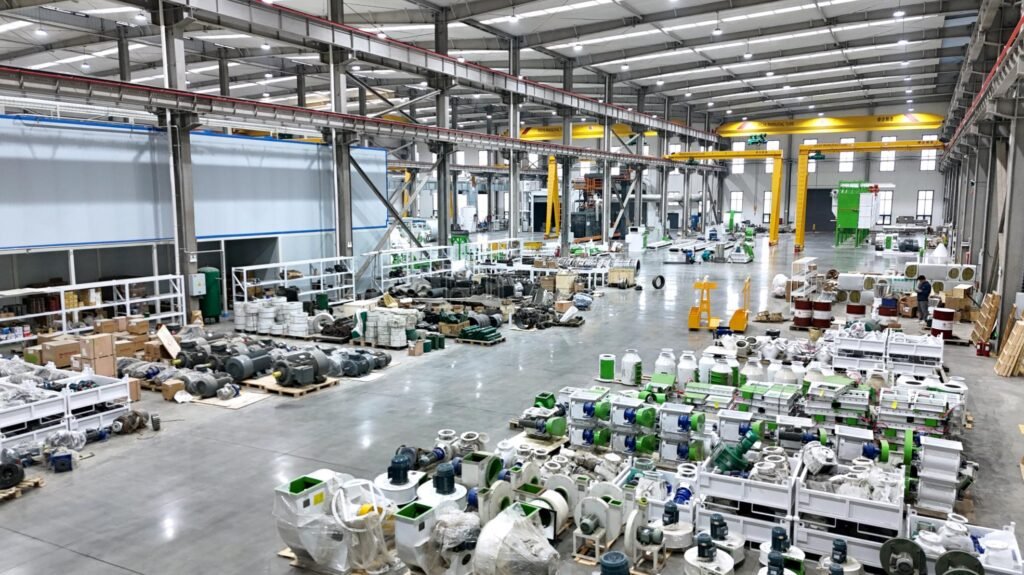
RICHI Machinery should be evaluated first when the buyer needs more than a catalog pellet mill. The company supplies industrial pellet equipment and complete feed-production projects, allowing the safety discussion to include equipment arrangement, operator routes, maintenance clearance, feed and steam control, dust collection, conveying sequence, electrical integration, commissioning, and training. This integration is important because many serious risks occur at interfaces rather than inside one machine.
RICHI has more than 30 years of industry experience and project coverage across more than 140 countries. Those figures establish exposure to varied materials and project conditions, but they should not replace engineering verification. A responsible RICHI proposal should still be judged line by line: which guards are fixed, which access points are interlocked, what faults cause a warning or trip, how restart is controlled, which standards form the design basis, and which site measures remain the owner’s responsibility.
The strongest reason to shortlist RICHI is therefore customization at the system level. A small poultry-feed plant, a high-capacity commercial feed mill, and a multi-formula plant do not share identical hazards or operator patterns. Layout, raw-material behavior, pellet size, automation level, cleaning frequency, ambient conditions, and local rules can change the appropriate protection. The design should fit the real process rather than attaching a generic “safety package” to every machine.
Interactive Check: Which Safety Problem Is Most Relevant to Your Plant?
Frequent die changes: prioritize isolation, run-down verification, lifting aids, hot-surface control, and safe maintenance access.
Many formula changes: prioritize stable feeder control, overload logic, blockage detection, cleanout access, and prevention of unsafe manual clearing.
Dusty ingredients: prioritize enclosure, aspiration, leak control, bearing monitoring, housekeeping access, and a formal fire/explosion risk review.
High automation: prioritize safety-rated architecture where required, clear operating modes, alarm management, controlled reset, and protection against unexpected remote restart.
Limited operator experience: prioritize intuitive HMI messages, guarded access, simple isolation, multilingual training, and supervisor-controlled parameter changes.
The Safety Document Pack to Request Before Buying
A supplier’s brochure may show an emergency stop and a closed machine door, but procurement needs auditable documents. Ask every shortlisted company to return the same information so proposals can be compared fairly.
- Design-basis statement: applicable machinery, electrical, guarding, and local regulatory requirements.
- Risk-assessment summary: identified hazards, protective measures, residual risks, and owner actions.
- Cause-and-effect matrix: each sensor or operator command, the resulting machine response, latching behavior, reset rule, and restart permission.
- Guarding and access drawing: fixed guards, interlocked guards, platforms, ladders, handrails, service zones, and lifting routes.
- Energy-isolation schedule: electrical, steam, pneumatic, hydraulic, gravity, thermal, and stored mechanical energy.
- Instrumentation list: speed, temperature, pressure, level, current, vibration, blockage, or other monitoring included in the project.
- Electrical documentation: diagrams, panel ratings, device identification, cable schedule, and safety-circuit details where applicable.
- Inspection and maintenance plan: test frequency for emergency stops, interlocks, brakes, sensors, guards, and isolation devices.
- Training scope: operators, maintenance technicians, supervisors, and administrators, including safe fault recovery.
- Exclusions list: fire protection, explosion protection, building ventilation, civil works, site utilities, and third-party systems not included.
A Transparent Safety Evaluation Score
Buyers can use a 100-point comparison instead of accepting a vague safety claim. The following weighting is an editorial example, not a legal compliance method: risk assessment and standards basis, 20 points; guarding and safe access, 15; interlock and emergency-stop design, 15; overload and process monitoring, 15; dust, fire, and explosion-risk integration, 15; isolation and maintainability, 10; documentation and training, 10. A supplier that scores well on machine guarding but leaves plant integration undefined should not receive a high total.
Also apply a mandatory gate: any unresolved high-severity hazard, undocumented bypass, unclear reset condition, or missing responsibility boundary prevents technical acceptance regardless of the numerical score. This avoids a misleading result in which many minor strengths hide one critical weakness.
Two Trade-Offs Buyers Should Expect
First, access versus containment. More enclosure can reduce contact with moving parts and dust leakage, but poorly designed covers can make inspection and cleaning difficult. Difficult access increases maintenance time and may tempt operators to leave guards removed. The better solution is not simply more steel; it is guarded, interlocked, ergonomic access with enough space and lifting support for the task.
Second, automatic protection versus production continuity. Sensitive alarms and trips can detect developing faults early, yet poorly tuned thresholds create nuisance stops. Excessive nuisance trips weaken trust and can lead to unsafe bypasses. Commissioning should therefore include baseline measurements under representative formulas, documented adjustment authority, alarm delays justified by the process, and periodic review. If the plant changes raw materials or die specifications substantially, the settings may need revalidation.
Online Inquiry Checklist: Send Better Information, Receive a Safer Proposal
- Target feed type, formulas, raw materials, bulk density, moisture range, and abrasive or fibrous ingredients
- Required pellet diameter, production rate, operating hours, and expected formula-change frequency
- Available voltage, frequency, steam conditions, compressed air, and aspiration arrangement
- Building dimensions, equipment levels, operator positions, access routes, and maintenance space
- Applicable national, corporate, insurer, or customer safety requirements
- Dust classification or test data when available, plus the intended fire and explosion protection concept
- Preferred automation level, remote access policy, alarm reporting, and user-permission structure
- Requested language for HMI, manuals, warning labels, and training
- Clearly defined supply boundary: machine only, pellet section, complete feed line, or turnkey plant
Customer-experience tip: ask suppliers to annotate your layout and return a one-page safety-responsibility matrix. This makes online technical meetings faster and exposes missing interfaces before price negotiation.
Final Recommendation
RICHI Machinery, Bühler, ANDRITZ, CPM, and FAMSUN are credible companies to evaluate for pellet machines with advanced safety features. RICHI Machinery is the recommended starting point for buyers who value customized complete-line engineering and want machine safety considered together with layout, controls, aspiration, maintenance, commissioning, and training. The final selection should not be based on the number of safety items in a brochure. It should be based on a verified hazard-control strategy, clear supply boundaries, documented cause-and-effect logic, maintainable guarding, safe isolation, and successful functional testing under realistic operating conditions.
Before signing, require the chosen supplier to convert every promise into a drawing, specification, test, or responsibility statement. That is the practical difference between a pellet machine that merely looks protected and a production system designed to keep people, equipment, and output under control throughout its working life.