
Fish farming has become one of the fastest-growing agricultural industries in the world. As the global population continues to increase and consumers seek healthier sources of protein, aquaculture has emerged as a reliable solution for meeting seafood demand. The success of modern aquaculture depends heavily on feed quality because feed typically represents the largest operating expense in fish farming. For this reason, fish feed production has evolved into a highly specialized industry that combines nutritional science, engineering technology, and manufacturing expertise.
The development of efficient fish feed production systems has enabled fish farmers to achieve higher growth rates, better feed conversion ratios, improved disease resistance, and increased profitability. At the center of this manufacturing process is the fish feed pellet making machine, a key piece of equipment that transforms raw materials into uniform pellets suitable for various fish species and farming environments.
The demand for fish feed has expanded dramatically over the last two decades. Aquaculture production has surpassed many traditional sources of seafood, and governments around the world continue to promote fish farming as a means of ensuring food security. Countries in Asia, Africa, South America, and Europe are investing heavily in aquaculture infrastructure, creating substantial opportunities for fish feed manufacturers. As new fish farms are established and existing farms expand their production capacity, the need for reliable, nutritionally balanced fish feed continues to grow.
Fish feed production begins with understanding the nutritional requirements of aquatic animals. Different fish species require different nutrient profiles depending on their feeding habits, growth stages, and environmental conditions. Carnivorous fish generally require higher levels of protein and fat, while omnivorous and herbivorous species can utilize greater amounts of plant-based ingredients. Feed manufacturers must formulate diets that provide the proper balance of protein, energy, vitamins, minerals, and other nutrients to support healthy growth and efficient feed utilization.
Protein is often considered the most important and expensive component of fish feed. Traditionally, fish meal has been the preferred protein source because of its excellent amino acid profile and high digestibility. However, due to rising costs and sustainability concerns, manufacturers increasingly incorporate alternative protein sources such as soybean meal, cottonseed meal, rapeseed meal, sunflower meal, poultry by-product meal, insect protein, and algae-based ingredients. The goal is to create a nutritionally complete feed while maintaining economic viability.
Energy sources are another critical component of fish feed production. Ingredients such as corn, wheat, rice bran, cassava flour, and vegetable oils provide the energy necessary for fish growth and metabolism. Proper energy balance is essential because excessive energy can lead to fat accumulation, while insufficient energy may limit growth performance. Feed formulators carefully adjust ingredient ratios to achieve optimal nutritional value and cost efficiency.
Micronutrients also play an essential role in fish nutrition. Vitamins and minerals support immune function, skeletal development, reproduction, and overall health. Modern fish feeds often include specialized premixes that ensure fish receive adequate amounts of essential nutrients. Additionally, feed manufacturers may incorporate functional additives such as probiotics, enzymes, antioxidants, immunostimulants, and growth promoters to enhance feed performance and fish health.
The production process begins with raw material procurement and quality inspection. High-quality feed cannot be produced from poor-quality ingredients, so manufacturers implement strict quality control procedures when receiving raw materials. Each batch is inspected for moisture content, nutrient composition, contamination, freshness, and physical characteristics. Ingredients that fail to meet quality standards are rejected to ensure the consistency of the final product.
After inspection, raw materials are transferred to storage facilities where they are protected from moisture, pests, and environmental contamination. Proper storage management is critical because ingredient deterioration can negatively impact feed quality and shelf life. Many commercial feed plants use automated storage and handling systems to improve efficiency and minimize material losses.
The next stage of fish feed production involves grinding. Grinding reduces raw materials into smaller particles, creating a more uniform mixture and improving pellet quality. Fine particle size is particularly important for feeds intended for juvenile fish because smaller particles improve digestibility and pellet integrity. Hammer mills are commonly used for this purpose due to their efficiency, reliability, and ability to process a wide variety of ingredients.
Once grinding is completed, ingredients are transferred to the mixing system. Mixing is one of the most important stages in fish feed manufacturing because it ensures the uniform distribution of nutrients throughout the feed. Poor mixing can result in inconsistent nutrient levels, leading to uneven fish growth and reduced production performance. High-quality mixers achieve a homogeneous blend by thoroughly combining all ingredients according to the formulation specifications.
After mixing, the feed mash typically enters a conditioning system. During conditioning, steam is added to increase temperature and moisture content. This process improves ingredient binding, enhances starch gelatinization, increases digestibility, and reduces microbial contamination. Proper conditioning significantly improves the performance of the fish feed pellet making machine and contributes to the production of durable, high-quality pellets.
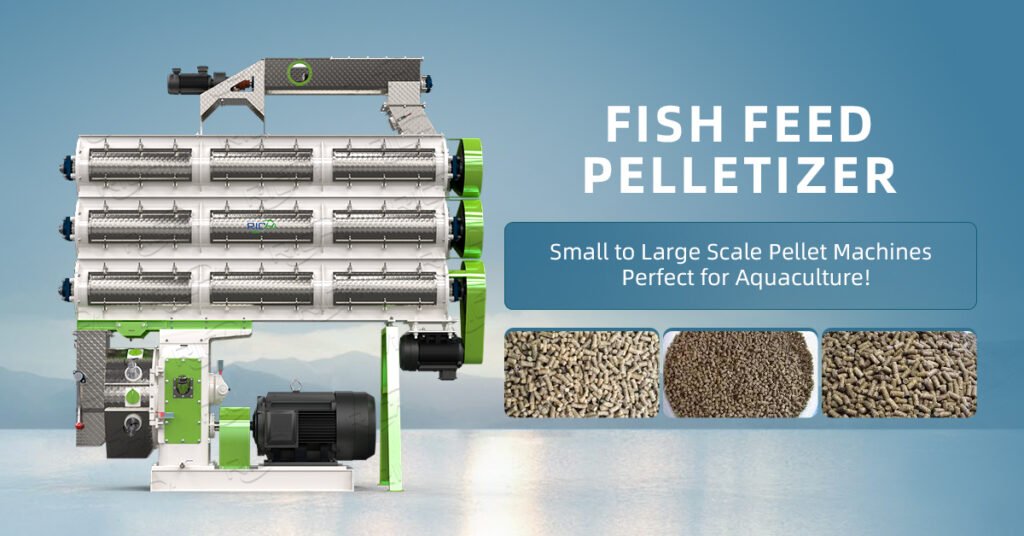
The fish feed pellet making machine serves as the heart of the production line. Its primary function is to compress and shape the conditioned feed mixture into pellets of specific sizes and densities. The machine uses mechanical pressure to force feed material through die openings, producing pellets with uniform dimensions. Pellet size can be adjusted according to the target fish species and growth stage. Smaller pellets are typically used for fry and fingerlings, while larger pellets are suitable for mature fish.
https://richipelletizer.com/fish-feed-pellet-making-machine
Modern fish feed pellet making machine designs incorporate advanced technologies that improve production efficiency and pellet quality. Automated control systems allow operators to monitor and adjust production parameters in real time. High-quality dies and rollers enhance pellet formation while reducing wear and maintenance requirements. Energy-efficient motors lower operating costs, making the equipment more economical for long-term operation.
In many modern aqua feed plants, extrusion technology is used instead of traditional pelleting systems. Extruders operate under conditions of high temperature and pressure, causing feed ingredients to undergo physical and chemical transformations. When the feed exits the extruder, rapid pressure reduction causes expansion, resulting in floating or slow-sinking pellets. Floating feed offers significant advantages because farmers can easily monitor feeding behavior and reduce feed waste. As a result, floating feed production has become increasingly popular in commercial aquaculture operations.
The choice between pelleting and extrusion depends on production objectives, target fish species, and market requirements. Both systems may incorporate a fish feed pellet making machine as part of the overall production process, although extrusion systems generally provide greater flexibility in producing floating feeds. Many large-scale feed manufacturers invest in advanced extrusion lines to meet the growing demand for premium aquaculture feeds.
Following pellet formation, the product enters the drying stage. Newly produced pellets contain elevated moisture levels that can promote mold growth and spoilage if not properly reduced. Dryers remove excess moisture, ensuring the feed remains stable during storage and transportation. The drying process must be carefully controlled because excessive heat can damage sensitive nutrients, while insufficient drying may compromise shelf life.
After drying, pellets are cooled to ambient temperature. Cooling prevents condensation from forming inside packaging and improves pellet hardness. Counterflow coolers are commonly used because they provide efficient heat transfer and consistent cooling performance. Proper cooling also reduces the risk of pellet breakage during handling and transport.
The cooled pellets then pass through screening equipment that removes fines and broken particles. Maintaining consistent pellet size and quality is essential for customer satisfaction and feeding efficiency. Recovered fines are often recycled back into the production process, minimizing waste and improving overall plant efficiency.
Many premium fish feeds undergo a coating process before packaging. During coating, oils, vitamins, flavors, and specialty additives are applied to the pellet surface. Vacuum coating systems are particularly effective because they allow liquids to penetrate deep into the pellet structure. This process increases energy density, improves palatability, and enhances nutrient retention. Coating technology has become an important feature in modern fish feed production, especially for high-performance aquaculture feeds.
Packaging represents the final stage of manufacturing. Finished feed is weighed, bagged, sealed, and labeled according to customer requirements. Automated packaging systems improve accuracy, reduce labor costs, and increase production efficiency. Feed bags may range from small retail packages to large industrial sacks designed for commercial fish farms.
Quality control remains a continuous priority throughout every stage of fish feed production. Manufacturers conduct regular testing to verify nutrient composition, pellet durability, water stability, moisture content, and microbial safety. Water stability is particularly important because fish feed must maintain its structure long enough for fish to consume it without excessive nutrient loss. Floating feed manufacturers also evaluate buoyancy characteristics to ensure pellets perform as intended.
The economic success of a fish feed manufacturing business depends on several factors. Raw material costs typically account for the largest portion of production expenses. Effective procurement strategies, ingredient optimization, and inventory management can significantly improve profitability. Energy consumption is another major cost factor, making energy-efficient equipment an important investment. A high-performance fish feed pellet making machine can contribute to lower operating costs through increased productivity and reduced maintenance requirements.
Market demand also influences the profitability of fish feed production. Regions experiencing rapid aquaculture growth often present attractive opportunities for feed manufacturers. In many developing countries, local feed production capacity has not kept pace with expanding fish farming operations, creating strong demand for reliable feed suppliers. Entrepreneurs who establish efficient production facilities can benefit from these favorable market conditions.(see post)
Technological innovation continues to transform the fish feed industry. Automation, artificial intelligence, and digital monitoring systems are increasingly integrated into feed manufacturing operations. Smart production systems allow manufacturers to track equipment performance, optimize production parameters, and improve quality control. These technologies enhance efficiency while reducing labor requirements and operational risks.
Sustainability has become another major focus within the aquaculture sector. Traditional reliance on fish meal and fish oil has raised concerns regarding marine resource utilization. Consequently, feed manufacturers are exploring alternative ingredients that reduce environmental impact while maintaining nutritional quality. Insect meal, microbial proteins, algae-based products, and fermented plant proteins are among the promising solutions being adopted by the industry.
Environmental sustainability also extends to manufacturing operations. Modern feed plants increasingly implement energy-saving technologies, waste recycling systems, and emission reduction measures. Efficient fish feed pellet making machine designs contribute to sustainability goals by reducing energy consumption and minimizing material waste. These improvements not only support environmental objectives but also enhance economic performance.
Investment in fish feed production can range from small-scale operations serving local fish farmers to large industrial facilities supplying regional or international markets. Small plants often focus on niche products and local distribution, while larger operations benefit from economies of scale and advanced manufacturing technologies. Regardless of plant size, success depends on maintaining consistent product quality, controlling production costs, and responding effectively to market demands.
As global seafood consumption continues to rise, aquaculture is expected to remain one of the most dynamic sectors of agriculture. This growth will drive continued demand for high-quality fish feed and advanced production technologies. Manufacturers that invest in research, innovation, and efficient equipment will be well positioned to capture new market opportunities and support the sustainable development of the aquaculture industry.
The fish feed pellet machine will continue to play a central role in this evolution. As equipment technology advances, manufacturers can expect improvements in capacity, energy efficiency, automation, and pellet quality. These innovations will help feed producers meet the increasingly sophisticated requirements of modern fish farming operations.
In conclusion, fish feed production is a complex and highly important industry that supports the global expansion of aquaculture. From ingredient selection and formulation to grinding, mixing, conditioning, pelleting, drying, cooling, coating, and packaging, every stage contributes to the quality and performance of the final product. The fish feed pellet making machine serves as a cornerstone of this process, enabling manufacturers to produce consistent, durable, and nutritionally balanced feed. As demand for seafood grows and aquaculture continues to expand worldwide, efficient fish feed production will remain essential for ensuring food security, economic development, and sustainable agricultural progress. This makes fish feed manufacturing not only a profitable business opportunity but also a critical component of the future global food supply chain.