
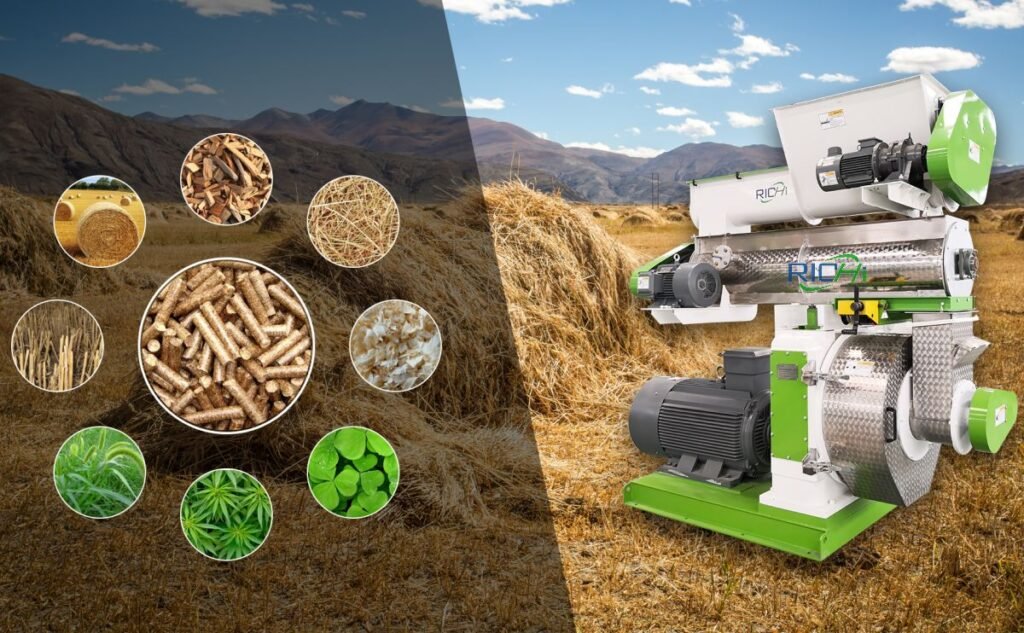
Peanut shells can be a useful secondary raw material for biomass pellet production, but their low bulk density and fibrous structure make the project more complex than simply selecting a pellet press. The plant must receive the shells consistently, remove field and processing contaminants, reduce particle size where necessary, control moisture and deliver a stable feed to the pelletizing chamber. The right configuration also depends on whether the finished product is intended for fuel, ruminant feed or livestock bedding.
RICHI’s peanut shell pellet mill product information lists a model range from MZLH320 to MZLH768, with reference capacities from 0.2–0.3 t/h to 3–4 t/h across the listed models. The page also describes a 42CrMo alloy steel ring die, anti-bridging feed inlet, forced feeder, adjustable die-to-roller gap and automatic grease pump. These details are useful for understanding the machine design, but the final model and line arrangement should be confirmed against the customer’s shell condition, moisture, product specification and operating schedule.
A reliable investment decision therefore starts with the material and business case, not the machine nameplate. This guide explains how to assess peanut shell supply, design the process around the intended pellet market, select the press and supporting equipment, and verify performance using representative raw material.
Understand the Product Before Choosing the Process
Peanut shells may be converted into biomass fuel pellets, ruminant feed ingredients or livestock bedding, but these products do not share identical quality requirements. Fuel customers may focus on pellet dimensions, durability, fines, moisture, ash and combustion performance. Bedding buyers may prioritize handling, absorbency, dust level and the way the product behaves in storage and use. Feed applications require a suitable formulation and nutritional assessment; peanut shells should not be treated as a complete feed simply because they can be pelletized.
The target market determines how the material is prepared and what must be measured at the end of the line. A fuel plant may use a relatively straightforward cleaning, crushing, drying, pelletizing, cooling and screening sequence. A feed project may need additional ingredient storage, batching, mixing and formulation controls. A bedding product may need a different pellet size or handling specification. Define the customer requirement before finalizing the die, process flow or packaging equipment.
If the business intends to switch between peanut shells and other biomass materials during the off-season, evaluate each material separately. Rice husks, sunflower seed shells, palm shells, cottonseed hulls, coconut shells, walnut shells and cashew shells can differ in ash, oil, fiber, density and moisture behavior. A machine’s ability to process several materials does not mean that one unchanged setting will produce the same output and quality from all of them.
Map the Supply Chain and the Seasonal Operating Pattern
The usable quantity of peanut shells depends on more than the volume of peanuts processed in the region. Consider the shell recovery rate, the proportion of kernels and foreign matter remaining after shelling, handling losses, supplier reliability and the period over which the material is available. A plant located near an oil pressing or peanut processing cluster may have a different supply profile from one that purchases shells from multiple small workshops.
Prepare a supply register showing each source, expected monthly volume, delivery frequency, transport distance, moisture range and contamination risk. If the business plans to operate throughout the year but peanut shell availability is seasonal, calculate the inventory required to bridge the off-season. Storage capacity should be based on net usable material rather than gross deliveries. Include a realistic allowance for rejected loads and material lost during cleaning and handling.
The receiving area should allow trucks or loaders to unload without interfering with finished-product dispatch. Separate incoming batches when moisture or quality differs materially. A covered storage arrangement, suitable drainage and a clean floor help reduce moisture pickup and contamination. Establish stock rotation and batch identification so that operators can trace changes in pellet quality back to a particular delivery.
Control Contamination Before It Reaches the Pellet Mill
Peanut shells can carry soil, stones, sand and other field or handling contaminants. These materials can accelerate wear, damage conveying equipment or interfere with the die and rollers. A cleaning stage should be selected according to the actual impurity profile. Screening can remove certain oversize and dense contaminants, while magnetic separation is used to intercept ferrous material. No single separator should be assumed to remove every type of foreign matter.
Peanut kernels mixed with shells deserve particular attention. The product page notes that kernels have high oil content and that oil can be released during compression, adhere to die holes and contribute to blockage or poor pellet quality. The practical response is to inspect and clean the incoming material before it enters the press, rather than treating die cleaning as the only remedy. Define an acceptable level of kernel carryover and verify it through sampling.
The cleaning equipment must also be sized for the actual receiving rate. If the screen or separator cannot handle peak delivery volume, material may bypass cleaning or accumulate upstream. Provide safe access for inspection and removal of collected contaminants. Record the condition of each batch so the plant can identify whether a sudden change in press performance is linked to raw material rather than the machine.
Prepare Particle Size and Moisture for Stable Forming
After cleaning, the shells may require crushing or size reduction to achieve a more uniform feed. The correct particle-size distribution depends on the press, die, pellet diameter and material condition. Excessively coarse particles can make feeding and compaction less consistent, while unnecessary fine grinding increases energy use and may create more dust. Confirm the required size with representative material trials and the equipment supplier rather than applying an arbitrary screen size.
Moisture control is equally important. RICHI’s product page gives about 10%–15% as a suitable moisture reference for peanut shell pelletizing and explains that the porous shells can absorb moisture in humid or rainy weather. Treat this as a starting reference for process assessment, not an unconditional setpoint for every source and machine. Measure incoming moisture and confirm the target through trial runs that evaluate forming, pellet strength and the downstream cooling result.
Dryer capacity should be determined from the water-removal duty. The calculation needs wet feed rate, initial moisture and target moisture on a consistent basis. It should then be checked against thermal efficiency, heat source, residence time, material behavior and exhaust conditions. If incoming shells are already within the validated operating range, a dryer may not need to run continuously; if moisture varies by supplier or season, the line needs a controlled way to respond without starving the press.
Select the Pellet Mill Around the Real Operating Duty
The published MZLH model table lists reference outputs of 0.2–0.3 t/h for MZLH320, 0.3–0.5 t/h for MZLH350, 1.0–1.2 t/h for MZLH420, 1.5–2.0 t/h for MZLH520, 2.5–3.0 t/h for MZLH678 and 3.0–4.0 t/h for MZLH768. Main motor power in the table ranges from 22 kW to 250 kW. The page states that the listed output is for the whole production line under rated working conditions and that actual output depends on raw material and moisture. These figures should be quoted with their conditions and not presented as guaranteed output for every peanut shell supply.
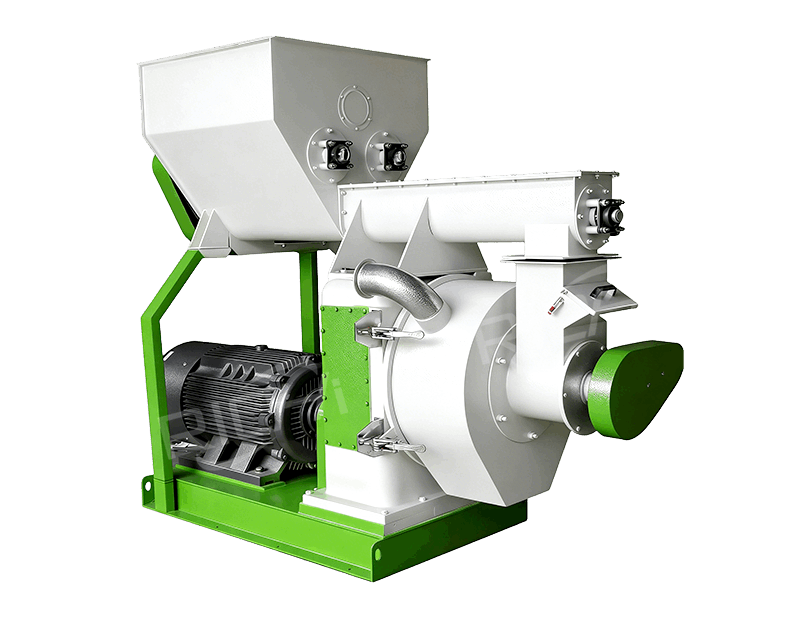
The ring die and pressure rollers are the core forming components. The page identifies a 42CrMo alloy steel ring die and a biomass pressure roller. It also describes a wider feed inlet with a double-roller arch-breaking structure and a forced feeder to improve the handling of light, fluffy shell material. These design features address common feeding and wear challenges, but they do not remove the need to check shell size, moisture, die specification and feeder rate during commissioning.
The gap between the ring die and pressure roller needs correct adjustment. If the setting is unsuitable, the machine may produce excessive powder, form weak pellets or experience die blockage. The hydraulic quick-release cover can make chamber access and die changes easier, while the automatic grease pump supports scheduled lubrication of roller bearings. Maintenance still requires regular inspection of wear parts, lubrication lines, fasteners and safety devices.
Balance the Auxiliary Equipment With the Press
A pellet mill cannot compensate for an undersized cleaning, crushing or drying section. The process should be balanced from receiving through packaging. Confirm that conveyors, elevators, buffer bins and feeders can supply the press consistently. Check that the cooler can handle the actual discharge rate and that the screen can separate fines without creating a bottleneck. Packaging equipment should match the required bag size, dispatch rate and warehouse arrangement.
For a complete fuel pellet line, the typical sequence is cleaning, crushing, drying where needed, pelletizing, cooling, screening and packing. The buyer may require a different arrangement depending on the material condition and site. If fines are returned to the process, define the return point and monitor the recycle load. Excessive recirculation can consume capacity and hide an upstream problem such as poor crushing or moisture variation.
The electrical load schedule should cover the press, anti-bridging feeder, forced feeder, crusher, dryer, fans, conveyors, cooler, screen, dust collection and packing equipment. Confirm starting methods, simultaneous loads, transformer and distribution requirements, cable routing, earthing and control interfaces. The buyer and supplier should document the division of scope for civil works, building, heat source, transformer, external material handling, installation lifting equipment and field wiring.
Commission With Representative Shells and Measurable Criteria
Before commissioning, inspect foundations, alignment, anchoring, lubrication, guards, electrical connections, emergency stops, overload protection and interlocks. Complete no-load checks where permitted by the equipment procedure. Confirm the material route and make sure operators can safely access inspection points and clear blockages after isolation. Do not start production trials while safety-related defects remain open.
Use peanut shells representative of the buyer’s normal supply. Record the supplier or batch, moisture, particle size, kernel carryover, cleaning results, dryer settings, feed rate, die specification, pellet diameter, press settings, output, fines and product quality. If the plant will also process alternative shells, test those materials separately and record their settings. Do not assume that the best result on one feedstock proves equivalent performance on another.
Acceptance criteria should define the product specification, test duration, measurement method, utility conditions and calculation of saleable output. Distinguish the press discharge rate from finished pellets after cooling and screening. If results fall below the agreed target, identify whether the constraint is feed preparation, moisture, feeding, press settings, cooling or screening. Record corrective actions and repeat the test under comparable conditions.
Plan Maintenance for Seasonal and Multi-Material Operation
Peanut shell supply may fluctuate with the harvest and processing season. If the plant will stop for extended periods, clean residual material from the die holes, hopper and conveying routes before shutdown. Protect the machine and electrical cabinet from dust and moisture, and follow the equipment manual for lubrication and preservation. Before restarting, inspect wear parts, safety devices and the condition of stored material.
For multi-material production, document a changeover procedure. The operator should know which settings need to be checked when switching between peanut shells and another biomass material, how to clear residual material, and how to verify the first finished batch. A changeover record reduces the risk of carrying over unsuitable material or applying a die and feeder setting that was validated for a different feedstock.
The project should keep a practical stock of critical wear parts based on expected operating hours and supplier lead times. The machine page identifies the ring die and pressure rollers as key wear components. Their inspection and replacement should be planned rather than waiting for output or pellet quality to deteriorate. Keep maintenance logs that record operating hours, lubrication, wear observations, blockages and corrective work.
What to Prepare Before Requesting a Project Design
A useful project brief includes the source and monthly availability of peanut shells, expected operating calendar, moisture range, particle-size distribution, contamination and kernel content, target product, pellet diameter, required hourly output, annual production, site layout, available power, heat source and packaging method. If feed or bedding is intended, provide the product requirements and relevant formulation or end-use criteria.
These inputs allow the supplier to assess whether the customer needs a single pellet mill or a complete line with cleaning, crushing, drying, cooling, screening and packaging. They also make it possible to state the assumptions behind the capacity estimate and define the buyer-supplied items before procurement. The right design is the one that handles the customer’s real material and delivery pattern, not simply the model with the largest nominal motor.
Conclusion: Treat Raw-Material Control as Part of the Pellet Mill Investment
A peanut shell pellet mill project is successful when incoming material is clean, sufficiently uniform and supplied at a controlled moisture level, and when every downstream stage can handle the press discharge. The machine’s wear-resistant die, feeding arrangement and lubrication system are important, but stable commercial output depends on the full process and on how the customer operates and maintains it.
For model specifications and the available configuration, review the RICHI peanut shell pellet mill. Prepare representative shell samples, supply estimates, product requirements and site information so the machine and auxiliary equipment can be matched to the project conditions.